The Psychology of Not Seeing: Why Hidden Object Games Trick Your Brain
The main challenge in Hidden Object Games is to find them (the objects), this however, is easier said than done. As the game moves on, the challenges become harder, and in all the clutter of trying to find that one “needle in a haystack”, one often wonders that despite scanning every nook and cranny on the scene, one still can’t find it. This is called a “Blind Spot” and (believe it or not), there is a science behind it.
Unlike an electronic or classic mechanical camera that absorbs and records everything within its scope of vision, the human eye is an organic camera connected to an equally organic brain. Human vision is highly selective, controlled by a filtering process of the brain. This let’s a person scan for the proverbial needle or object in a haystack of clutter, and when found, technically, it is the brain that recognizes it. This is also the “Achilles Heel”, because the brain can only do so much to process everything, not only your vision but practically every bodily function that keeps your heart beating. It’s busy, and although it may have a gazillion bytes of memory storage, humans do not have the processing speed of even the most outdated modern-day computer. Missing an object in plain sight is the result of the limitations of visual cognition.
Human Visual Processing
When we look at everything around us, everything is in high resolution, roughly 576 megapixels. However, this is an illusion because in reality, only a tiny area in the center of the retina called the “Fovea” can actually see in high-res. The fovea only covers about the width of your thumb held at arm's length, that’s it. Everything outside this tiny “field of view” (FOV) is blurry and lacks color.
To compensate for this limitation, the eye makes quick jerky motions called “saccades” landing on different points of what one is generally looking at. Between these jumps, the eye will pause for a fraction of a second in a "fixed state" to absorb whatever information it can. While you are searching through a cluttered environment, or a cluttered screen when you play hidden object games online, your brain will stitch all this tiny high-res snapshots together and derive the information from that. However, if your eye movements skip over a portion or part of a scene by just a few millimeters, that item in that portion will remains within the blurry peripheral vision and is practically invisible to your current focused visual attention.
Seeing but Not Seeing
Just because you are looking at something does not mean that you are really seeing it. It’s like looking at a really cute girl with an equally cute little doggy, and depending on your “social preferences”, you either see the Girl or the Doggy! The brain is not a computer processor and cannot analyze every single detail in a cluttered scene, it resorts to selective attention to compensate and ends up filtering out irrelevant information.
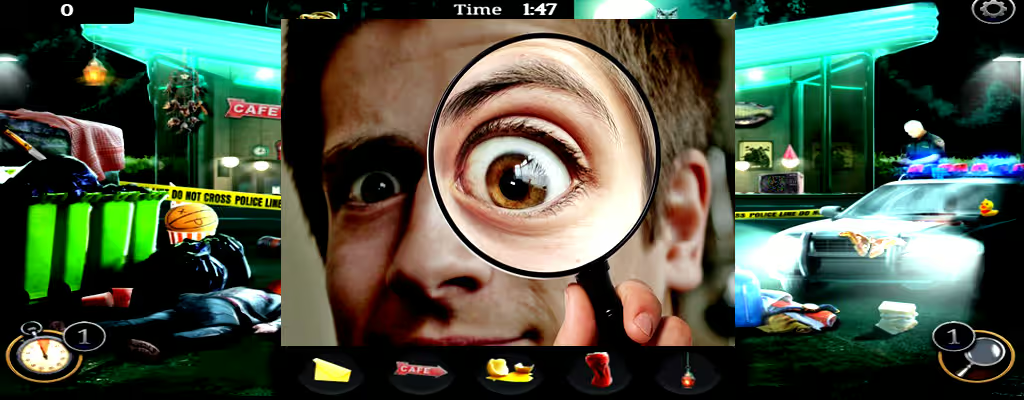
When your mind is deeply focused on finding a specific item, it creates a psychological filter. Let’s say you are looking for a bullet shell in a cluttered crime scene while playing hidden objects games online, your brain will actively filter what it sees in favor for something that looks like a bullet shell, the shape, the size (ex. 9mm), the color, etc., and to this, it may completely ignore any other thing even if you are looking directly at it. Your eye(s) sees them but your conscious mind rejects the information because it does not match what you are looking for.
The Art of Game Camouflage
Hidden Objects and generally, puzzle game designers are experts at exploiting camouflage and how the brain groups visual information. The human brain automatically groups items that share similar colors, shapes, or distance. So, designers place a brown leather belt over a brown leather chair to mask it. An object that shares features and characteristics with its background lacks "visual salience”, so it does not pop out.
Unfortunately, your brain sees the entire chair and belt as one object rather than two distinct objects, and this is what trick you to not seeing what is there. Breaking this “mental grouping” needs conscious and effortful analysis, which is exhausting for your cognitive eye-brain processing, and game designers are aware of that.
The Brain Gets Tired
Searching through a super-cluttered or super-neatly cluttered scene requires a lot of mental energy. Your current working memory has to simultaneously keep track of the items you need to find and the areas of the scene that you have already searched. Your cognitive exhaustion begins setting in and you begin to slip. You may end up re-scanning the same area of the overall scene while neglecting another. After scanning a spot 2 or 3 times, your brain will mark the area as empty in your mental map. On your next pass, your brain may totally skip that same area to conserve energy, blinding you to any item hidden there.
When you miss finding an object several times, this does not mean a failure of intelligence, rather, it is a side-effect of an optimized brain trying to save energy. HOG game designers use these cognitive limitations to create gaming tension and when you finally find that object, that needle in a haystack, your brain gets a sudden doze of high-octane Dopamine as a direct result of your brain breaking free of its self-imposed “Blind Spots”.
Related Articles