Common Mistakes Hidden Object Game Designers Make
We still see some flaws in how these hidden object games are designed and since we’re seeing them, we thought we’d share the common mistakes that these designers make.
Hidden object games seem easy to design from the outside. Toss a bunch of stuff into a scene. Make some of it hard to spot. Add a hint button. Done, right? Not even close. A good hidden object game feels satisfying, clever, and just a little sneaky. A bad one feels like somebody emptied a junk drawer onto the screen and called it a puzzle.
That difference matters a lot, especially now that players have so many free hidden object games to choose from. If a game feels sloppy, frustrating, or lazy, people leave fast. They are not going to sit there respectfully enduring bad design out of loyalty to the genre. They are going to click away and never think about your haunted parlor again.
Hiding things badly instead of cleverly
This is the biggest mistake right away. A lot of designers confuse difficulty with invisibility. A hidden object should be tricky to notice, not impossible to see because it is the same color as the wall, shrunk to the size of a breadcrumb, and buried under six unrelated props that all look like they were pasted in during an argument. That is not clever. That is visual sabotage. Good hiding feels fair. The object belongs in the scene. It blends naturally, but not stupidly.
Making scenes messy with no visual logic
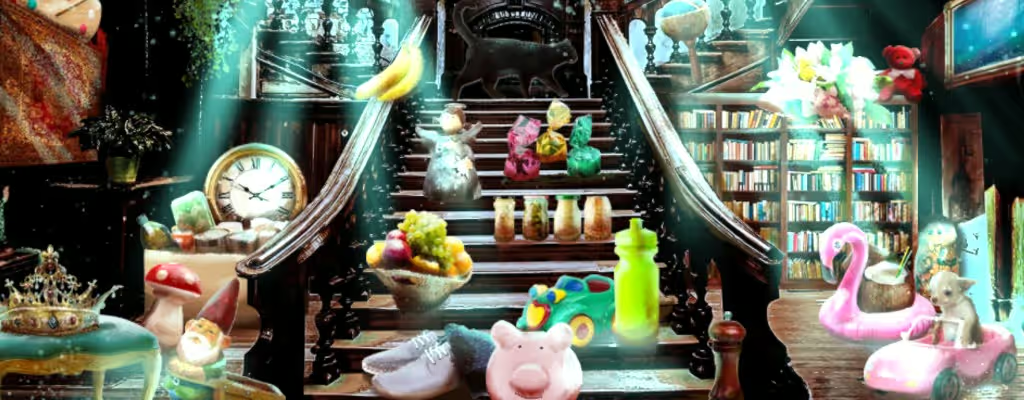
Clutter is part of the genre. Obviously. But there is a huge difference between rich detail and complete nonsense. Some hidden object scenes are so overloaded that they stop feeling like real places and start feeling like a thrift store exploded inside a fever dream. That hurts the game.
Players need visual hierarchy. Their eyes need some structure, some rhythm, some sense that the environment is still a place rather than a punishment. If every inch of the scene is screaming at the same volume, the player stops observing and starts suffering. A strong hidden object scene has texture and density, but it also has flow. Your eye should move through it, not trip over it repeatedly.
Repeating the same object tricks too often
Players are smart. They notice patterns fast. If every level keeps hiding objects behind curtains, inside flowerpots, or tucked into the same style of visual camouflage, the game starts feeling predictable. That is death for a genre built around attention. The best hidden object design keeps changing how it thinks.
Sometimes the challenge should come from shape. Sometimes color. Sometimes distraction. Sometimes angle. Sometimes context. If the same hiding trick gets recycled over and over, players stop engaging with the scene and start scanning for your habits instead. That makes the game feel smaller than it is.
Forgetting that atmosphere matters too
A hidden object game is not just a puzzle list floating in space. Mood matters. Setting matters. Sound matters. A lot. Some designers treat atmosphere like optional wallpaper, which is a mistake. The scene should feel like somewhere. A cozy kitchen. A suspicious forest. A cluttered antique shop. A strange hallway where something feels slightly off. That sense of place is what makes searching fun rather than mechanical.
Hint systems that either baby you or abandon you
Hints are another place where design goes wrong fast. Some games make hints so generous that you barely need eyes anymore. Others make them so limited or useless that they feel like decorative lies. Neither is great. A good hint system should help without robbing the player of satisfaction. It should nudge, not solve the whole room like an overbearing relative. At the same time, it should actually be useful when the player is stuck, because being stuck too long in a hidden object game turns calm focus into pure irritation.
Weak object lists and boring variation
Another common mistake you’ll notice if you play hidden object games online is making every level feel like the same shopping list in a different room. Cup. Key. Hat. Apple. Clock. Fine once. Not fine forever. Object variety matters. So does presentation. Silhouettes, riddles, partial objects, themed searches, anomaly spotting, layered interaction, these all help keep the genre alive. If every scene plays the same way, the player’s brain goes into autopilot. That is when boredom sneaks in.
When hidden object games get that balance right, they are fantastic. Quietly addictive. Atmospheric. Weirdly relaxing. But when designers miss the point, the whole experience collapses into eye strain and resentment.
Related Articles